Practice makes perfect! Explore our official practice tests today and boost your confidence before test day. Shop now!
Remove Product?
Are you sure?
If you leave the process before checking out, your order will be lost.
Driving Innovation for Educator Learning with Generative AI Teaching Simulations
From personalized learning to immersive teaching simulations, AI is reshaping professional development for educators worldwide. Discover how ETS is pioneering GenAI-powered practice spaces that empower educators to engage students more effectively and drive meaningful learning outcomes.
AI is transforming learning and assessment and is being used in educational contexts in varied ways to empower diverse learners worldwide. One transformative potential of AI is supporting educator learning through the development and deployment of generative AI (GenAI) tools like interactive chatbots where educators can practice and improve in their ability to engage in high-leverage teaching practices, such as engaging students with subject matter or orchestrating productive discussions. At ETS, a cross-disciplinary team of researchers, AI engineers, software developers, learning scientists, and educators have been collaborating to design and study the use of GenAI digital teaching simulations as online practice spaces that can help educators develop their instructional skills so they can learn how to be high-quality practitioners who can positively impact student learning and engagement.
Designing GenAI Teaching Simulations
The design process begins with determining the key instructional skills needed for educators to engage successfully in a high-leverage teaching practice. Then, for each instructional skill, it is important to identify the various aspects of the instructional skill that can be observed in a performance task, such as a GenAI teaching simulation. For example, one of the key instructional skills in engaging students with subject matter is being able to elicit and attend to student thinking, which involves several key teaching aspects and elements as shown in Table 1 (Qi & Sykes, 2015). These aspects and elements can serve as the starting point for providing educators with personalized feedback on their strengths and areas for growth in this instructional skill.
Table 1: Key Aspects and Elements in Eliciting and Attending to Student Thinking
The next step is to develop a teaching scenario that can elicit evidence of an educator’s ability to engage in these aspects and elements. In the first GenAI teaching simulation we developed, Cecilia, our first-grade GenAI student, had previously solved an addition word problem correctly, although it was unclear what problem-solving process she used or what she did or did not understand about strategies for adding. These components need to be elicited from the educator to understand what Cecilia did, what she knows, and gaps in her understanding. Educators have opportunities to practice eliciting Cecilia’s problem-solving process and conceptual understanding in this topic area – either through a text-based chat or a speech-based version (Video 1). Transcripts of their GenAI teaching simulation session can be used to support them in reflecting on their teaching practice and considering what they did well and how they can improve in future interactions – with simulated or real students.
Video 1:
Text & Speech Based GenAI Teaching Simulation: Strategies for Adding
Text & Speech Based GenAI Teaching Simulation: Strategies for Adding
Evaluating GenAI Teaching Simulations
Before integrating the GenAI teaching simulations within varied educator learning contexts, we rigorously test and evaluate each GenAI teaching simulation to ensure that it is working as intended and providing educators with meaningful learning opportunities to engage in the focused instructional skill (Mikeska & Bhatia, 2025). Our research team developed and has been using a multi-dimensional framework to evaluate the current GenAI teaching simulations to ensure that the GenAI student’s responses: (a) are responsive to the educator’s prompt or question, (b) provide adequate information, (c) are age and grade-level appropriate, (d) use an appropriate emotional tone, (e) are coherent, and (f) are aligned with the GenAI student’s knowledge profile, which specifies their background knowledge and content understandings and misunderstandings (Mikeska et al., 2025a).
Using GenAI Teaching Simulations
The final – and most exciting and impactful – step is using these GenAI teaching simulations to support educator learning within various learning settings! One productive approach is to integrate the GenAI teaching simulations as part of online learning modules where educators can learn about ways to engage in specific instructional skills – for example, different strategies they can use to elicit and attend to student thinking – and then engage in a GenAI teaching simulation to apply the new strategies they learned. Another possibility is integrating the GenAI teaching simulations as part of teacher education university courses where university professors can use them as part of course assignments and preservice teachers can try out and reflect on their ability to productively engage in specific instructional skills within the simulation (Mikeska et al., 2025b; Mikeska, Bhatia, Halder et al., 2025). Finally, they can be used as substantive learning opportunities within in-service teacher school district-based professional development workshops or professional learning communities.
Applying GenAI Insights: ETS’s High Leverage Practice Modules
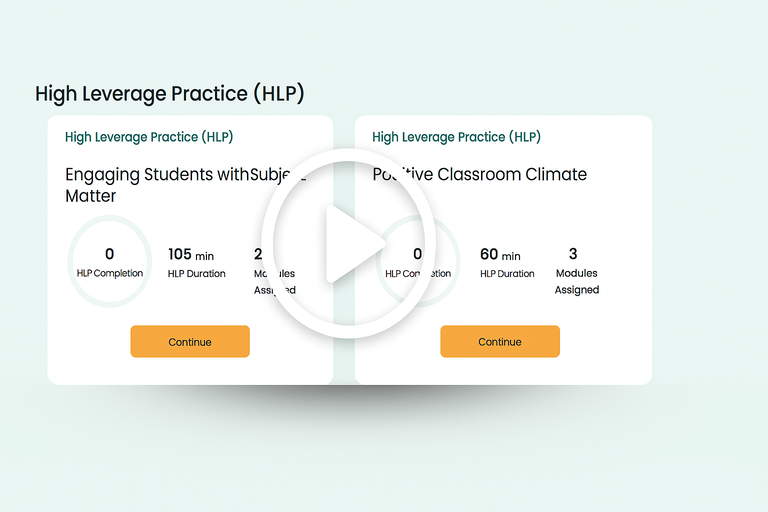
At ETS, we are not only exploring the potential of GenAI teaching simulations—we are actively applying these insights to create innovative learning solutions. Our newly released High Leverage Practice Modules (HLPs) for paraeducators leverage GenAI-powered simulations to provide authentic, interactive practice opportunities focused on essential instructional skills. These modules are designed to help elementary paraeducators build confidence and competence in high-leverage practices through structured, feedback-rich experiences that mirror real classroom interactions. By combining cutting-edge GenAI technology with research-based instructional frameworks, ETS is driving the next generation of professional learning tools that empower educators to make a meaningful impact on student learning.
Managing Principal Research Scientist, ETS Research Institute
References
Mikeska, J.N., Beigman Klebanov, B., Bhatia, A., Halder, S., & Suhan, M. (2025a, July 22-26). Evaluating the use of generative artificial intelligence to support learning opportunities for teachers to practice engaging in key instructional skills. In A.I. Cristea, E. Walker, Y. Lu, O.C. Santos, & S. Isotani (Eds.) Artificial Intelligence in Education. Artificial Intelligence in Education, Proceedings, Part II (pp. 378-391). AIED 2025. Lecture Notes in Computer Science, vol 15878. Springer. https://doi.org/10.1007/978-3-031-98417-4_27
Mikeska, J.N., Beigman Klebanov, B., Bhatia, A., Halder, S., Shekell, C., Jorgenson, H., Maxwell, T., & Longwill, B. (2025b). Using generative AI digital teaching simulations as practice spaces to support personalized and adaptive learning for preservice teachers in an elementary math methods course. [Manuscript submitted for publication]. Research Institute, ETS.
Mikeska, J.N., Bhatia, A., Halder, S., Beigman Klebanov, B., Maxwell, T., Longwill, B., & Shekell, C. (2025, October 27-29). Generative AI teaching simulations as formative assessment tools within preservice teacher preparation. [Paper presentation]. Artificial Intelligence in Measurement and Education Conference, Pittsburgh, PA.
Qi, Y., & Sykes, G. (2016). Eliciting student thinking: Definition, research support, and measurement of the ETS® National Observational Teaching Examination (NOTE) assessment series (Research Memorandum No. RM-16-06). Princeton, NJ: Educational Testing Service. https://files.eric.ed.gov/fulltext/ED570608.pdf









.jpg?sw=768 "The word AI sits on top of a microchip.")





.jpg?sw=768 "Two people - a man and a woman - sit at a desk together in front of an open laptop comupter. To the left of them: a sign reading \"ETS Praxis and Study.com\"")